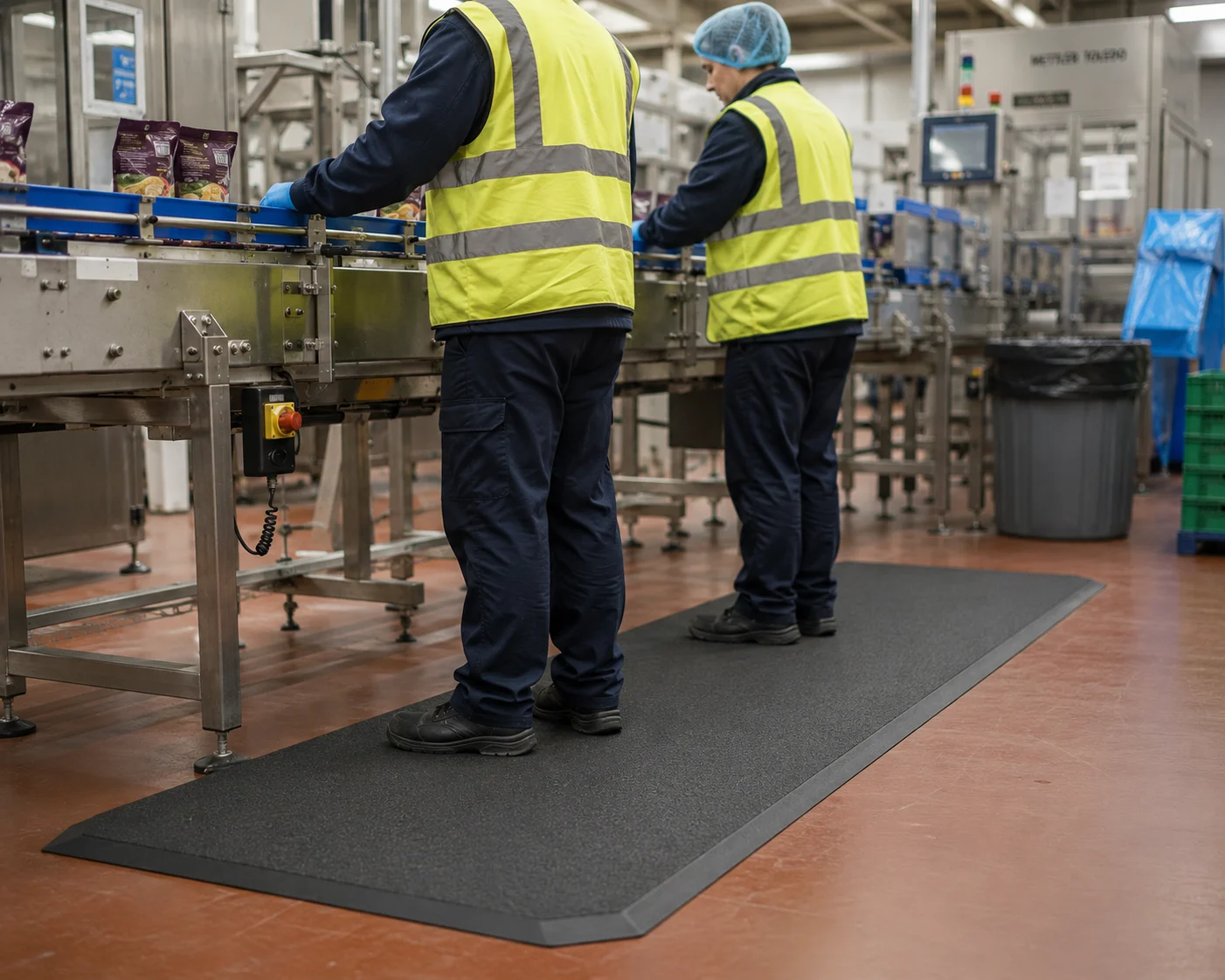
A standard mat is one fixed shape. The M5 tile system is whatever you build. 46 × 46 cm interlocking PVC tiles lock together to cover any footprint, from a single bench to a whole production cell, then finish with bevelled edging. Here's how to size it, build it, and pick the right tile.
Dry areas
M5 Anti-Fatigue Tile
Closed-surface interlocking tiles (R10) for prolonged standing at dry workstations.
View the tile
Wet areas
M5 Drainage Tile
Open-surface tiles that let liquid fall through, in the same interlocking system.
View the drainage tile
The system
One tile, any floor
M5 is a modular anti-fatigue floor built from interlocking PVC tiles, made in the UK (West Midlands) from recycled PVC. Each tile measures 46 × 46 cm, is 2.5 cm thick and weighs 2.5 kg, covering about 0.21 m², so roughly 5 tiles per m². Tiles are supplied in boxes of 10, and 15 × 46 cm half tiles are available for tight runs.
The point of the system is flexibility. Because you build the floor tile by tile, you can match the footprint of a bench, a cell, or a walkway without forcing it into a stock mat size. As the workspace changes, tiles lift out and re-lay in a new layout, and if one tile takes damage you replace just that tile instead of a whole mat.
| Tile size | 46 cm × 46 cm × 2.5 cm (15 × 46 cm half tiles available) |
|---|---|
| Coverage per tile | ≈ 0.21 m² (roughly 5 tiles per m²) |
| Weight | 2.5 kg per tile |
| Pack size | Boxes of 10 tiles |
| Material | Recycled PVC, made in the UK (West Midlands) |
| Slip resistance | R10 standard tile; R13 (DIN 51130) gritted anti-slip tiles |
| Reaction to fire | Cfl-s2 (EN 13501-1) standard, gritted and antimicrobial; ESD tiles Efl-s2 |
Pick the tile
Closed, drainage, or specialist?
Same modular system, same 46 × 46 cm format: the difference is the surface. The first question is simple: does liquid reach the floor? Then decide whether the area needs extra grip, hygiene, or static control.
M5 Anti-Fatigue Tile
Closed surface · R10
The everyday modular floor for dry standing areas.
- Assembly and production cells
- Packing and inspection benches
- Workshops and light engineering
- Retail, trade counters, and warehouse pick faces
M5 Anti-Fatigue Drainage Tile
Open surface · liquid drains through
For standing areas where water or other spills would otherwise pool on the mat surface.
- Wet process and wash-down areas
- Machine fronts where liquid reaches the floor
Specialist M5 tiles
- Anti-slip gritted tiles, closed or drainage, rated R13 under DIN 51130 for the most slippery floors.
- Antimicrobial tiles, closed or drainage, for hygiene-sensitive areas.
- ESD tiles, static dissipative, for electronics work.
- Heavy-duty tiles for tougher floors.
Standard, gritted and antimicrobial tiles are rated Cfl-s2 for reaction to fire under EN 13501-1. ESD tiles are rated Efl-s2, so keep them out of welding and hot works areas.
Build it
From bare floor to finished mat
Measure the area
Work out the floor area in square metres for the workstation, cell, or walkway you want to cover. The shape can be irregular: you build to fit, so there's no need to force the area into a neat rectangle.
Count your tiles
Divide the area by 0.21 m² per tile, round up, then round up again to whole boxes of 10. A 10 m² zone needs 48 tiles, so 5 boxes, which also leaves a couple of spares for tricky corners or a replacement on hand.
Prep the floor
The floor should be clean and dry before you lay the tiles. A good surface is what lets the tiles sit flat and stay locked together.
Lock the tiles together
Interlock the tiles to build the area, working outward from one corner. Because nothing is fixed down, any tile can be lifted out later to re-lay the layout or replace a damaged piece.
Finish the perimeter
Close the open edges with male and female edging pieces and corner pieces, in yellow for a high-visibility perimeter. The edging bevels the edge of the mat for a trip-safe finish. Full-size edging is 10 × 46 cm, matching one tile edge, and mini edging is also available.
Coverage maths
How many tiles and edging pieces?
Tiles
Area ÷ 0.21, rounded up to boxes of 10
Each tile covers about 0.21 m². Take your floor area in square metres, divide by 0.21, round up to the next whole tile, then round up to whole boxes.
10 m² ÷ 0.21 ≈ 47.6 → 48 tiles → 5 boxes of 10
Edging
One full-size piece per exposed tile edge
Each full-size edging piece is 46 cm long, the same as one tile edge. Count the exposed tile edges around the perimeter, use male or female pieces to suit the tile edge, and add a corner piece at each outside corner.
Finishing pieces
- M5 full-size edging, male and female
- Mini edging and corner pieces, in yellow for a high-visibility perimeter
Single workstations
Or skip the maths with a kit
For one standing position, an M5 anti-fatigue workstation kit comes pre-sized at 112 × 112, 158 × 112 or 249 × 112 cm, with tiles, edging and corners in one box per station. See all workstation kits.
Need help sizing up? Our sizing & coverage guide walks through measuring a workstation, or book a free site visit and we'll check the layout.
Modular vs roll
When modular beats a single mat
A standard mat or roll is the simplest answer for one fixed, rectangular workstation. Modular tiles earn their place when the floor isn't that tidy. You can build to any footprint, lift and re-lay the area whenever the cell changes, and replace a single damaged tile rather than scrapping a whole mat.
That makes the system a strong fit for irregular layouts, growing production cells, and floors that take heavy localised wear in one spot. For a wider look at how modular tiles stack up against other formats, see our modular matting comparison. If you're weighing fixed comfort mats instead, the M1 vs M2 guide covers the foam-mat ranges, and the anti-fatigue mats shop lists the M5 anti-fatigue tiles alongside them.