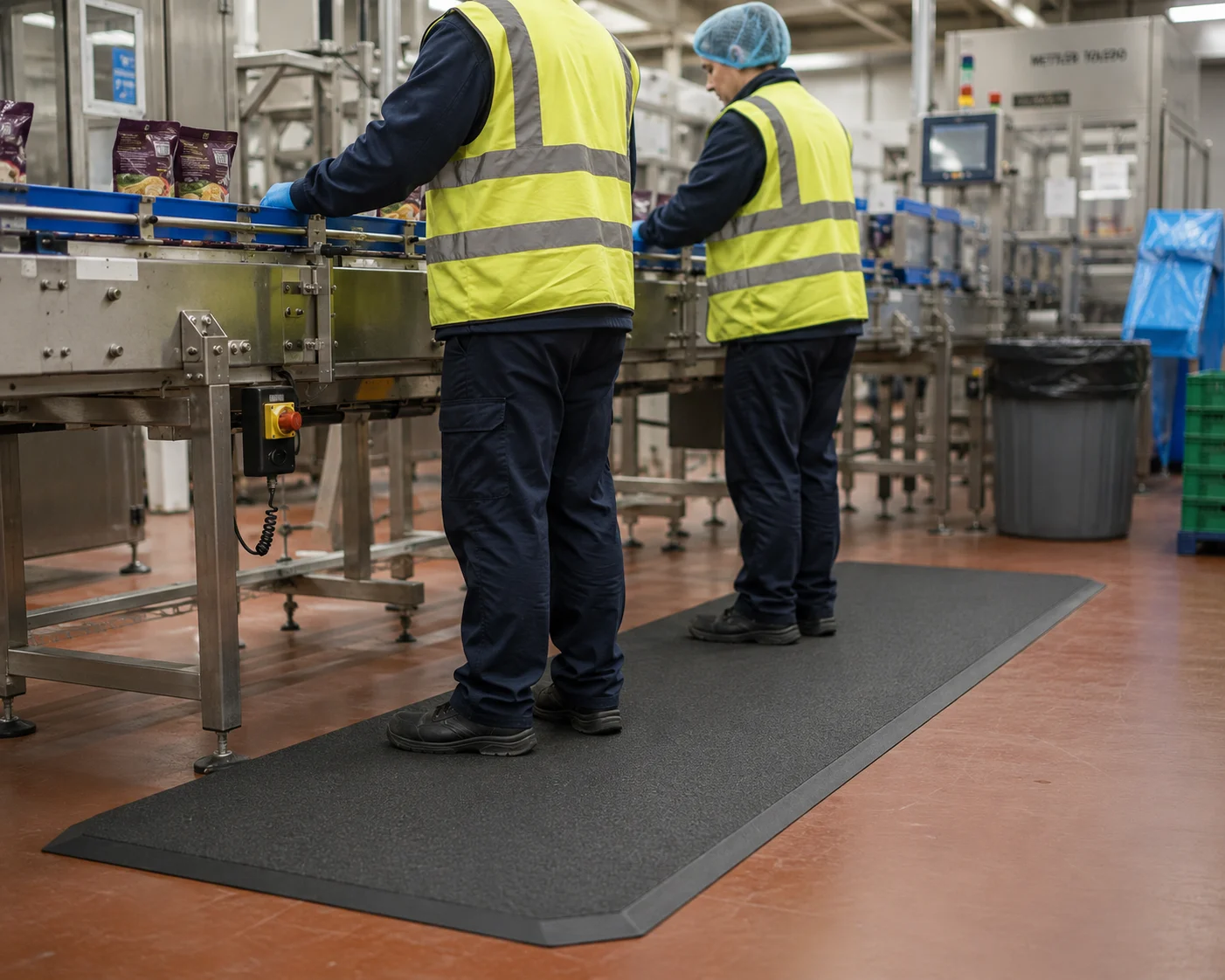
Three formats cover almost every job: a standard mat for one workstation, a full roll or cut-to-length for a line or bench, and modular tiles for any footprint. This guide shows how to pick the format and work out coverage — with simple maths, no guesswork.
One workstation
Standard mat
Cover the standing footprint plus room to step back and turn. One standard mat usually suffices.
From £25.11 · How to size
A line or area
Roll, cut-to-length or tiles
Run continuous matting along the working edge, or click modular tiles to any footprint — no trip edges.
From £43.14 · Work out coverage
Pick a format
Standard mat vs roll vs cut-to-length
| Format | Best for | Why |
|---|---|---|
| Standard Mat | One standing workstation | Fixed sizes, simplest choice — one mat per operator. Smallest standard size is 60 cm × 91 cm. |
| Full Roll | Long runs along a line or bench | A continuous roll means fewer seams across a long run. |
| Cut to Length | Made-to-measure runs | Cut to your exact run length and priced per linear metre. |
Cut-to-length and roll orders are confirmed by the sales team before processing. No payment is taken online.
Sizing one standing workstation
- Cover the operator's standing footprint
- Add room to step back and turn
- A single standard mat usually suffices
- Smallest standard size is 60 cm × 91 cm
Sizing a bench or production line
- Run the mat along the length of the working edge
- A roll or cut-to-length avoids gaps between mats
- No butted seams means no trip edges along the line
- Confirmed by the sales team before processing
Coverage maths
Working out tile coverage for an area
Area first: measure the zone and multiply — area = length × width (in metres). A 3 m × 2 m standing zone is 6 m².
Tile count: the M-Lock interlocking tile system uses 91 cm × 91 cm tiles, each covering about 0.83 m². So tile count = area ÷ 0.83, rounded up. For 6 m² that's 6 ÷ 0.83 ≈ 7.2, so order 8 tiles, then finish the perimeter with safety ramps. Tiles click together to any footprint, so they're the flexible alternative when a single mat won't cover the space.
Trip safety: leave clear, bevelled or ramped edges. Butting several loose mats together creates trip edges, so for continuous standing a roll, cut-to-length, or a modular tile system is the safer choice across a larger area.
Choosing between series? See M1 vs M2, the surface types explained guide, or the full M-Series overview. Deep-link straight to M1 or M2.