Two numbers on an anti-fatigue mat spec do most of the heavy lifting: its duty rating and its standing time. Get them right and the mat lasts and supports your operators; get them wrong and you've under-spec'd the job. Here's what each means in plain English — and how to match them to a workstation.
Duty rating
How hard-wearing
Light, medium, or heavy duty — how much continuous standing and footfall the mat's construction is built to take.
Standing time
How long per shift
The guideline for how long an operator stands per shift that the mat is designed to support.
Term 1
What "duty rating" really means
A duty rating describes how heavy-use a mat is built for: light, medium, or heavy duty. It isn't a comfort score on its own — it's a function of the mat's construction and durability under continuous standing and footfall. A heavier duty mat uses a denser, harder-wearing build so it keeps its support and shape when it's stood on all day, every day.
Comfort itself comes from three performance attributes that sit alongside the duty rating: cushioning (the give underfoot), pressure distribution (how evenly the mat spreads load away from pressure points), and bounce-back (how quickly it returns to shape so it keeps supporting through the shift). Maximum Matting's M2 rates very high on pressure distribution and bounce-back, which is exactly what an all-day standing role needs.
In the M-Series, M1 is light-to-medium duty and M2 is medium duty — built tougher for heavier, continuous standing.
Term 2
What "standing time" means — and how to estimate it
Standing time is the guideline for how long an operator stands per shift that the mat is designed to support. It's the bridge between the spec sheet and the real workstation: a mat rated for intermittent standing won't carry a full continuous shift, and a full-shift mat is over-kill where someone only stands for short bursts.
Estimate it in four steps
- Watch a typical shift and note roughly how many hours the operator is actually on their feet.
- Separate continuous standing from alternating sit/stand or walking-away time.
- Round up to the nearest band: intermittent / part-shift, or full continuous shift.
- Match that band to the mat's standing-time guideline — don't pick below it.
Two common bands
Part-shift / alternating: up to around 3 hours on your feet, or sit/stand work that swaps between standing and sitting. This points to a lighter-duty mat — M1.
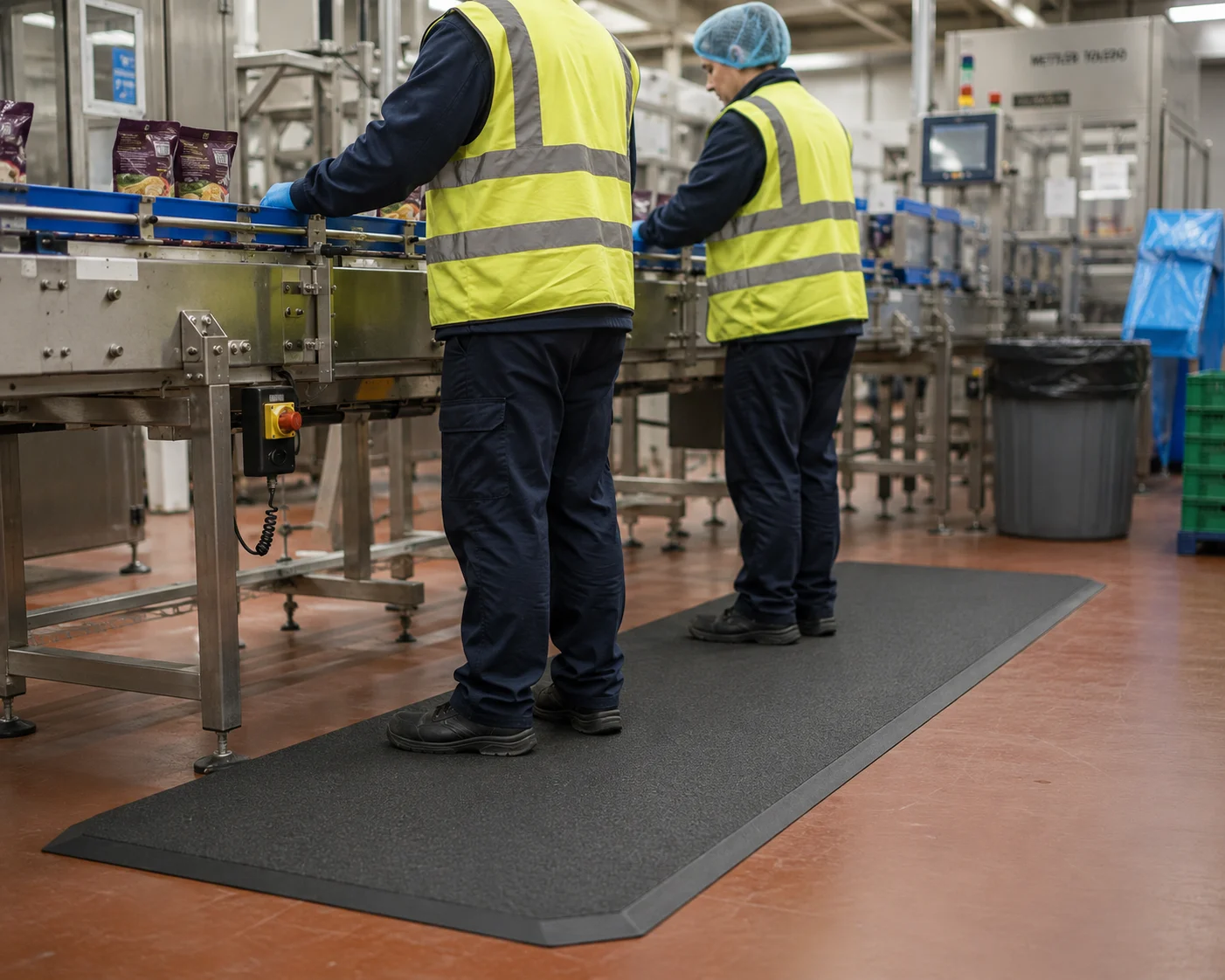
Full continuous shift: operators on their feet for a full 8-hour shift on a line or bench. This needs a higher-duty, full-shift mat — M2.
Match it up
Duty & standing time to mat
| Duty rating | Standing time | Best fit | Typical workstation |
|---|---|---|---|
| Light to medium duty | Up to ~3 hours / alternating sit-stand | M1 Comfort | Counters, reception, sit-stand desks, light benches |
| Medium duty | Full 8-hour shifts | M2 Comfort | Assembly, packing, production lines |
Need a side-by-side on the two mats? See the M1 vs M2 guide.
The trap
Don't under-spec the duty rating
The most common mistake is putting a light-duty mat into a full-shift role to save a little upfront. Under-spec'ing backfires twice: the mat wears out faster because it isn't built for that level of footfall, and it gives less support over a long shift as the cushioning works harder than it was designed to. Spec to the actual standing time and the mat lasts longer and keeps performing.
Matching duty and standing time is also part of looking after the people standing on the mat. For the legal and duty-of-care framing around providing suitable matting, see our HSE requirements guide. And once you've picked a duty level, our sizing & coverage guide helps you work out how much mat the workstation needs.
Up to ~3 hours
M1 Comfort
Light-to-medium duty for part-shift standing, counters, and sit-stand desks.
From £24.99 · Shop M1 mats
8-hour shifts
M2 Comfort
Medium duty engineered for full continuous shifts in assembly, packing, and production.
From £42.99 · Shop M2 mats