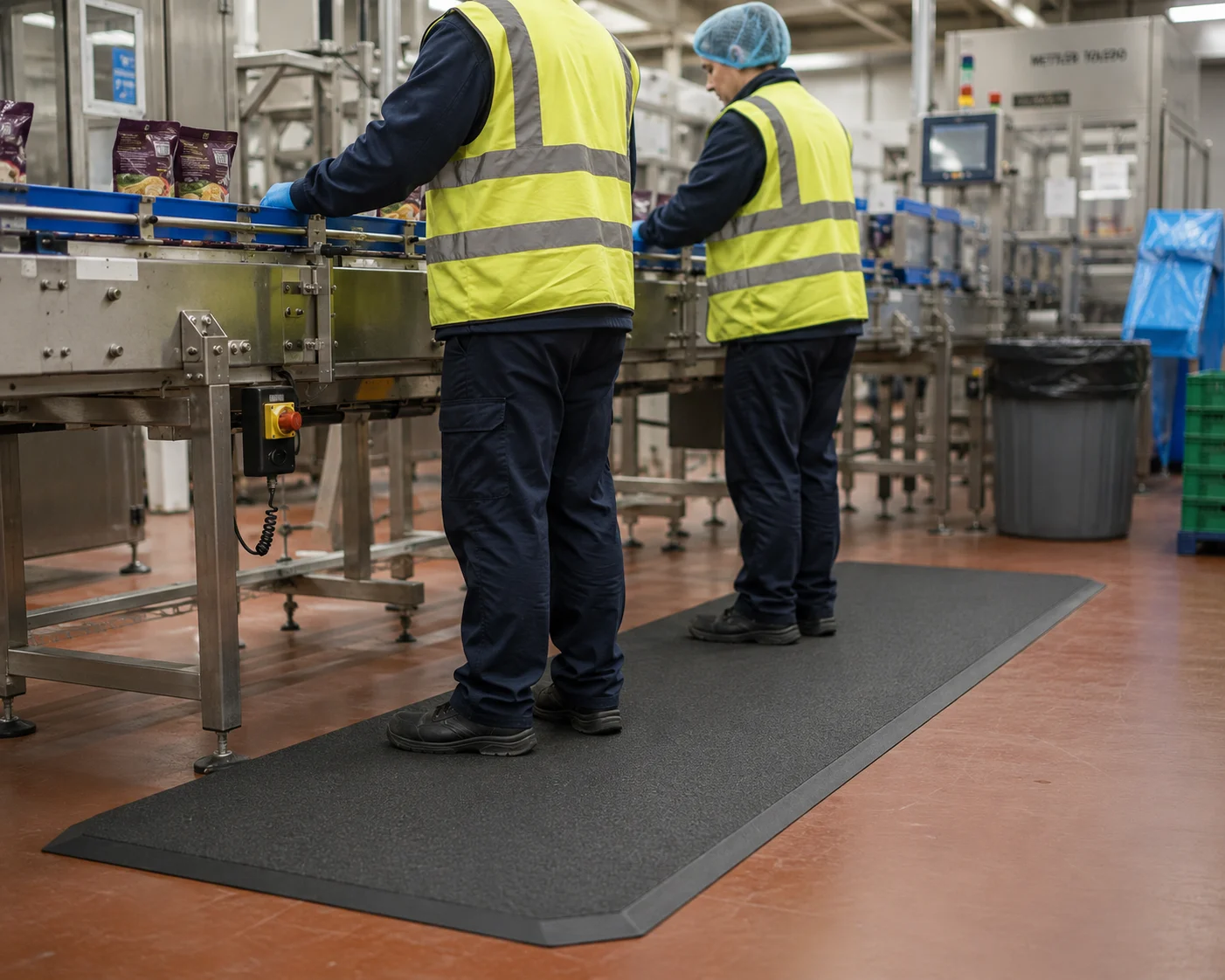
Warehouse and distribution centre workers spend hours standing at packing stations, picking areas, and despatch zones. The right anti-fatigue matting reduces strain, boosts productivity, and cuts injury-related absences. This guide compares the best options for UK logistics operations.
Top 5 anti-fatigue mats for warehouses
Comparing the leading anti-fatigue matting products for UK warehouses and distribution centres.
| Product | Brand | Material | Slip Rating | Sizes | Price | Best For |
|---|---|---|---|---|---|---|
| ⭐ M5 Modular | Ergo Advantage | 100% recycled PVC | R13 | 112×112cm to 249×112cm | Mid-range | Packing stations, flexible layouts |
| Fatigue-Step | COBA Europe | Nitrile rubber / PVC | R10 | Tiles and rolls | Mid-range | Long picking aisles |
| Cushion-Ease | Notrax | Nitrile rubber | Varies | 91×91cm tiles | Premium | Heavy-duty despatch |
| Deckplate Connect | COBA Europe | PVC | R10 | Interlocking tiles | Mid-range | Walkways, aisles |
| Superfoam | Notrax | PVC foam | R10 | Various | Budget-Mid | Light-duty stations |
Our top picks explained
M5 Modular System
Ergo Advantage
M5 is ideal for warehouse environments where layouts change frequently. Packing stations get reconfigured, seasonal peaks require additional workstations, and operational improvements mean constant evolution. The interlocking modular system handles this perfectly—no adhesive means easy repositioning.
Manufactured in the West Midlands from 100% recycled PVC, M5 helps warehouses meet sustainability targets increasingly demanded by retail partners and logistics contracts. The R13 slip rating provides enhanced safety in environments where packaging materials and shrink wrap create slip hazards.
Pros:
- ✓ Reconfigurable for changing layouts
- ✓ 100% recycled—meets retailer sustainability audits
- ✓ R13 slip rating for debris and packaging
- ✓ Large tiles reduce installation time
- ✓ Free CAD layout support for planning
Cons:
- ✗ No roll format for very long runs
- ✗ Not for forklift traffic areas
Best for: Packing stations, pick-and-pack areas, returns processing, any warehouse area with standing workers and changing layouts.
COBA Fatigue-Step
COBA Europe
Fatigue-Step's roll format makes it efficient for covering long picking aisles where workers stand while scanning and selecting items. Available in various widths, it can be cut to length on-site, reducing waste in linear applications.
Pros:
- ✓ Roll format ideal for long aisles
- ✓ Cut to length on-site
- ✓ Established COBA supply chain
Cons:
- ✗ Harder to reconfigure than tiles
- ✗ May need adhesive for permanent fit
Best for: Picking aisles, goods-in stations, long linear workstations.
Notrax Cushion-Ease
Notrax / Justrite
Cushion-Ease is a premium modular option for warehouses with budget for higher-specification matting. The 19mm thickness provides maximum cushioning for despatch areas where workers stand for entire shifts.
Pros:
- ✓ 19mm premium cushioning
- ✓ Modular interlocking system
- ✓ Perforated drainage option
Cons:
- ✗ Premium pricing
- ✗ Smaller tiles (91×91cm)
Best for: High-specification despatch areas, premium logistics operations.
COBA Deckplate Connect
COBA Europe
Deckplate Connect offers a harder-wearing surface suitable for walkways and transitional zones in warehouses. While providing less cushioning than dedicated anti-fatigue mats, it's more durable for areas with occasional trolley traffic.
Pros:
- ✓ Harder wearing surface
- ✓ Handles light trolley traffic
- ✓ Interlocking system
Cons:
- ✗ Less cushioning than dedicated anti-fatigue
- ✗ Not for prolonged static standing
Best for: Warehouse walkways, transitional zones, areas with mixed pedestrian and trolley use.
Notrax Superfoam
Notrax / Justrite
Superfoam is an entry-level option from the Notrax range, suitable for light-duty warehouse applications or areas where workers stand for shorter periods. It provides basic fatigue relief at an accessible price point.
Pros:
- ✓ Lower price point
- ✓ Notrax brand quality
Cons:
- ✗ Foam material wears faster
- ✗ Less suitable for heavy-duty use
Best for: Light-duty stations, office areas within warehouses, break areas.
What to look for in warehouse anti-fatigue mats
Layout Flexibility
Warehouses evolve constantly—seasonal peaks, process improvements, and layout changes are normal. Modular interlocking mats can be reconfigured without waste. Consider whether you'll need to move matting within the next 2-3 years.
Slip Resistance
Warehouse floors collect cardboard dust, shrink wrap, and packaging debris. Higher slip ratings (R13 vs R10) provide better grip in these conditions. Check that matting maintains grip when contaminated with common warehouse materials.
Sustainability Requirements
Major retailers and logistics contracts increasingly require sustainability evidence. M5's 100% recycled content and UK manufacturing help meet audit requirements from companies like Amazon, Tesco, and major 3PLs.
Edge Treatment
Bevelled or ramped edges prevent trip hazards, especially important in busy warehouse environments. Ensure edges are included in your specification. Most quality modular systems offer compatible edge pieces.
Cleaning & Maintenance
Warehouses require regular cleaning. Choose mats that can be pressure washed, swept, or scrubbed. Modular tiles can be lifted for cleaning beneath—useful in areas where debris accumulates under workstations.
Temperature Tolerance
Ambient warehouses, chilled storage, and loading bays have different temperature ranges. Verify that your chosen matting performs across your temperature range, particularly for cold storage applications.
Warehouse zones
Matting by warehouse area
Packing Stations
Workers stand 6-8 hours. Need maximum cushioning. Layouts change seasonally.
Recommended: M5 Modular
Picking Aisles
Long linear areas. Workers move but stand while scanning. Fixed layout.
Recommended: Fatigue-Step rolls
Goods-In / Despatch
Heavy-duty areas. May have spillages. Need durability.
Recommended: Cushion-Ease or M5
Warehouse anti-fatigue mats: Common questions
What is the best anti-fatigue mat for warehouse packing stations?
Do warehouse anti-fatigue mats work with pallet trucks?
How do I calculate how much matting I need for a warehouse?
Are anti-fatigue mats suitable for cold storage warehouses?
How long do warehouse anti-fatigue mats last?
Related guides